Digital Platforms for NGOs in Madagascar and Africa
Insights/ Madagascar & Africa Digital Insights / ngo-platforms
29 Jul 2025 - 05 min read
Why this is harder than it looks
NGO platforms in Madagascar and across Africa rarely fail at the build phase. They fail somewhere else, usually in the gap between the funder pitch, the field reality, and the year that follows the launch event.
A platform built only around the funder narrative looks impressive at the steering committee. A platform built only around the field team is pragmatic but tends to under-report. A platform that lasts is one where both audiences see something useful, every week, without arguing about whose turn it is to update the data.
This article is a working playbook for the operations leaders who actually carry that weight.
Start with what the field teams need on a Tuesday morning
The single most reliable test of an NGO platform is what a field coordinator opens on Tuesday morning. If they open the platform, the platform is going to live. If they open a WhatsApp group and a spreadsheet, the platform is going to drift, regardless of how clean the data architecture is.
Before designing the platform itself, sit with two or three coordinators and watch what they do for an hour. The questions to bring back: what do they look at first? Which information do they re-type from one place to another? What do they avoid because it takes too many clicks on a slow connection?
Those answers shape the platform far more than the funder dashboard ever will.
Multilingual is a structural decision, not a translation task
In a Madagascar or wider African context, "multilingual" is not a UI toggle added at the end. It is a structural decision about which language the underlying data lives in.
A few practical rules:
- Pick the working language of the field team as the primary data language, even if the funder reports go out in another.
- Do not store partial translations in the same field, separate fields, with explicit fallback rules.
- Accept that the donor-language version will lag, and design the workflow so that the lag does not block decisions on the ground.
This is mostly architecture and governance, not vocabulary.
Design for connectivity that is not always there
Connectivity in much of Madagascar and rural Africa is not absent, it is intermittent, expensive on mobile data, and slow on shared offices. That has consequences for the platform:
- Pages that work offline or degrade gracefully are not a luxury; they are the difference between use and abandonment.
- Forms must save partial input. A coordinator who loses thirty minutes of work to a dropped connection will not return that afternoon.
- Image and document uploads need a queue, not a blocking dialog.
A platform that assumes office-grade broadband is a platform that quietly excludes its own users.
Data, donors and reporting, three audiences, one source of truth
NGO platforms typically serve three audiences with different needs:
- The field team, who needs operational visibility this week.
- The management team, who needs trend visibility this quarter.
- The donor or board, who needs accountability this year.
Each audience usually arrives with its own template, often incompatible with the others. The trap is to build one screen per audience and then let them drift.
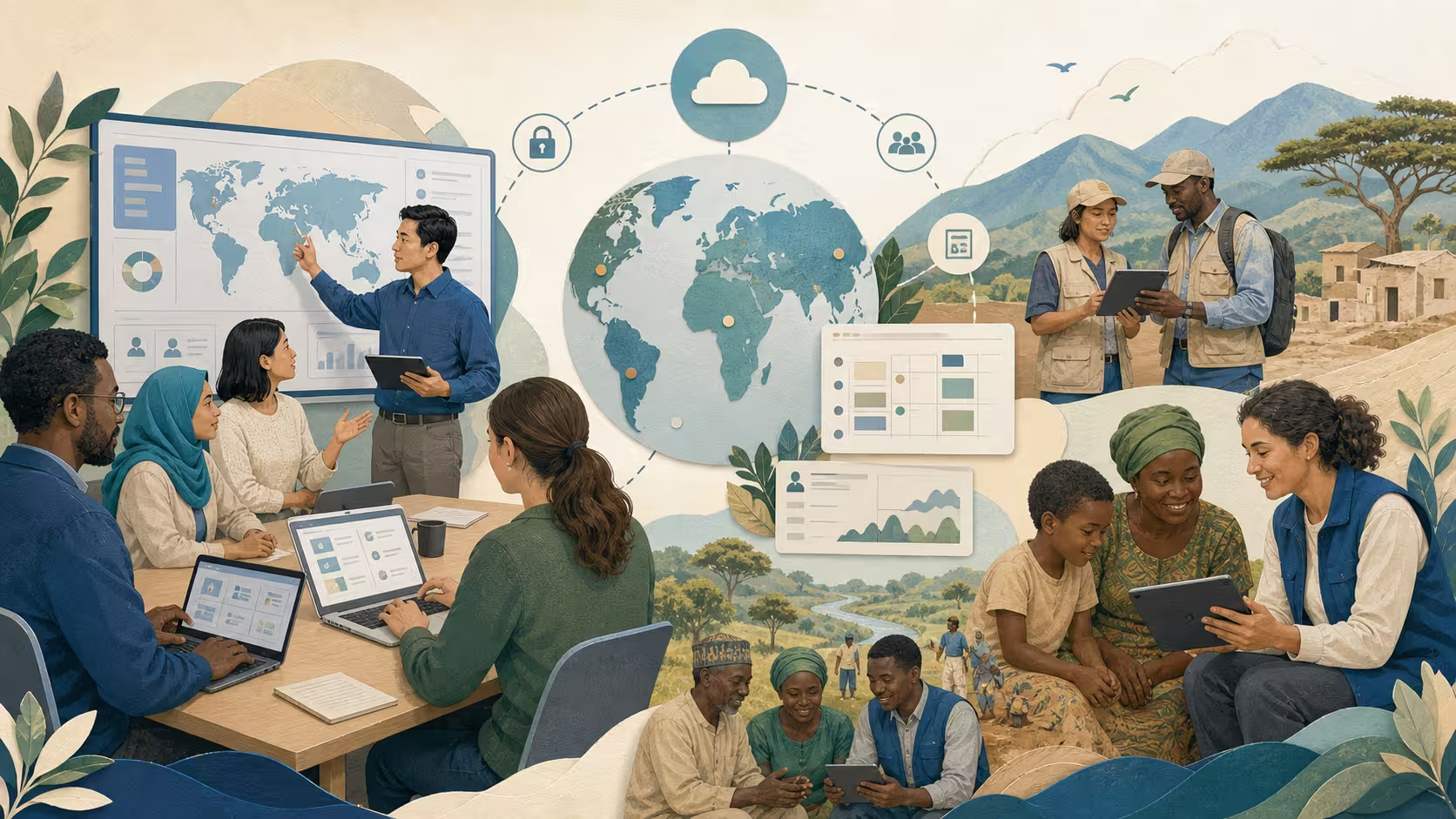
A more sustainable design is one source of truth at the level of the smallest meaningful event, a household visit, a training session, a stock movement, and three views layered on top. Reporting becomes a query, not a re-entry exercise. That single design decision saves more staff hours over a year than any other.
Who owns the platform after the project closes
NGO digital platforms have a sustainability problem that corporate platforms rarely face. The project that funded the build is often time-bound. The maintenance is not.
Three questions to answer in writing before the platform is built:
- Who pays for hosting, domain renewal, and security updates after the project closes?
- Who holds the credentials, the source code, and the documentation in a form a successor can use?
- Which functions are core to the mission, and which become dispensable when budget tightens?
Without those answers, even excellent platforms quietly degrade in the eighteen months after launch, locked accounts, expired certificates, stale content, broken integrations.
Governance: the boring decisions that decide everything
The governance of an NGO platform is rarely glamorous, but it is where most platforms quietly fail. A short list of decisions that should be made, and written down, before the platform goes live:
- Who approves new fields, new modules, and new data flows.
- Who can edit historical records, and under what audit trail.
- How decisions to change the platform are recorded, so that two years later, no one is asking why a field exists.
The list is short on purpose. NGO operations teams already carry too much process. Three clear rules consistently applied are worth more than thirty rules nobody remembers.
A practical close
The NGO platforms that last are not always the most ambitious. They are the ones where the field team trusts the data, the management team trusts the reporting, and the funder trusts the trail, without any of them needing to call the others to reconcile what they are looking at.
Most of that work happens before the first line of code is written, and most of the rest happens in the year after the launch event. If that is the kind of platform you are designing, or recovering, the NGO and institutions cluster on this site is where I collect the related analyses, and the digital platforms practice for NGOs and organisations is where these problems get worked on directly.
- Haja Faniry
Related services
Custom Digital Platforms for NGOs & Organisations
Development of digital platforms and data systems for NGOs, research institutions and international organisations.
Digital Transformation & Technology Solutions
Digital transformation consulting and technology solutions to automate workflows, modernize digital infrastructure and support organisational growth.
Digital Communication & Content Strategy
Digital communication and content strategy consulting to improve online visibility, SEO performance and digital engagement.