
Digital Transformation for NGOs and International Organisations
Insights/ Digital Transformation / Organisation Use Cases
07 Mar 2023 - 06 min read
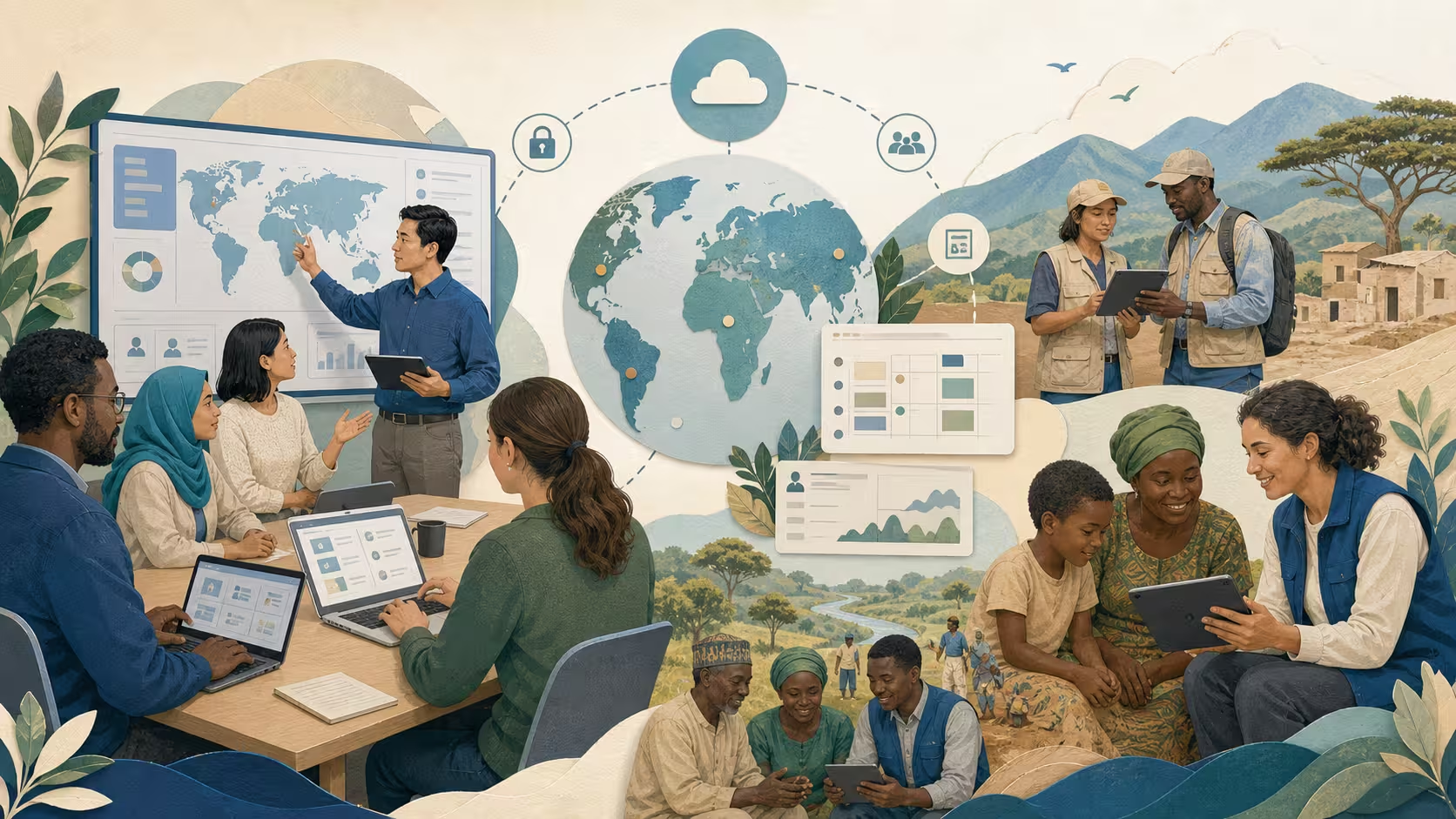
What makes NGO digital transformation different
Most playbooks for digital transformation are written for the corporate world: stable funding, a single language, a head office that can hire its own product team, and a customer who pays for the service. NGOs and international organisations operate in almost none of those conditions. Funding is project-based and time-bound. The users are field teams in places where bandwidth is intermittent and infrastructure is unreliable. The "customer" is often a beneficiary who will never pay anything, while the funder is on a different continent and reports up to its own board on a different cycle.
That does not make NGO digital transformation harder than the corporate version, it makes it differently shaped. The risks are not in the technology choices; they are in the assumptions baked into how the work is funded, who owns the platform on day 731, and whether the field team can still log a case from a saturated mobile network in a regional office during the rainy season. This article walks through the constraints that decide whether an NGO transformation actually lands.
The funder paradox: funded to launch, not to maintain
The defining structural problem of NGO digital transformation is that grants typically cover the build but not the run. A donor funds an 18-month project to deploy a new beneficiary management system. The project closes on time, the platform is in production, and the budget that paid for the developers, the cloud infrastructure and the support desk evaporates. Two years later, the system is either stuck on an unsupported version of its dependencies, or quietly abandoned in favour of a spreadsheet that someone re-built because it was easier to ask for.
The honest fix is not technical, it is financial: the total cost of ownership, including hosting, support, security patching, training of new joiners and small ongoing improvements, has to be costed and named at the proposal stage, and either built into the original grant, into a successor grant, or absorbed into the organisation's core budget. Where that conversation does not happen up front, the platform's lifespan is set by the original funding cycle, regardless of how well it was built. The full pattern is mapped out in what digital projects need to succeed in emerging contexts, which sits closer to the field reality than most procurement documents admit.
The field reality: low connectivity, multilingual, mobile-first
The team that is supposed to use the system rarely sits in a head-office building with reliable fibre. They sit in a regional office on a 3G connection, on a motorbike between sites, or in a community centre that has electricity for six hours a day. Whatever the platform looks like in a Paris or Geneva demo, the field experience is what determines whether real data gets entered, or whether the team falls back to paper forms that get re-typed into the system three weeks later by someone who was not there.
Three constraints recur. The first is bandwidth: the system has to work on slow and intermittent connections, with offline capture for the moments where there is no connection at all. The second is language: head-office English or French is rarely the working language of the people doing the data entry, and a system that requires translating one's own work into another language at the moment of entry will produce data nobody trusts. The third is devices: the realistic assumption is a low-end Android phone bought two or three years ago, not a laptop, and certainly not the latest model. Designing for that environment is a deliberate choice. Designing for a modern desktop browser and assuming it will "also work on mobile" is the default that quietly produces unusable systems.
Serving the donor without crushing the field
NGO platforms have to do two jobs that often pull in opposite directions. They have to serve the field, make programme delivery faster, safer and better-documented for the people doing it. And they have to serve the donor, produce indicators, monitoring data and accountability reporting against a logframe written before the project started.
When those two jobs are not designed together, one wins and the other loses. If the platform is built around the donor's reporting requirements, the field experience becomes a long form that field teams resent and fill in badly, which corrupts the very indicators the donor wanted in the first place. If it is built only around the field experience, the data is good but cannot be aggregated into the indicators the donor needs, and the next grant becomes harder to win. The right design is one where the field workflow naturally generates the donor data as a by-product, not as a separate step. That requires the M&E team and the field operations team to be in the room together at design time, which is a governance choice more than a technical one.
What sustainable looks like in practice
A sustainable NGO platform looks different from a sustainable corporate platform in three specific ways.
First, the technology stack is deliberately boring. Boring frameworks, boring databases, boring hosting, the kind of things a junior developer hired locally three years from now can still maintain. Cleverness in the stack is a luxury only organisations with a permanent in-house engineering team can afford.
Second, the knowledge does not live with the contractor who built it. The handover plan is part of the project from day one, not an afterthought at closeout. Documentation is written for the maintainer, not the funder. Local capacity is genuinely transferred, meaning the local team can not only operate the system but also extend it, debug it, and decide when to retire it.
Third, governance survives staff rotation. The platform owner is not "the project officer who left for a different agency last summer", but a named role inside the organisation that persists when individuals move. This is the same governance discipline that makes any transformation programme survive its sponsor, adapted to an environment where rotation is faster and funding is fragmented.
Final takeaway
NGO and international-organisation digital transformation is not a budget-trimmed version of the corporate playbook. It is a different problem with a different shape, defined by funding cycles that end, field environments that constrain, and reporting obligations that cut across the work. The platforms that last are the ones designed for those realities up front, not retrofitted to them after launch.
The wider context, what makes digital projects last in environments with limited budgets, intermittent connectivity and rapid staff rotation, is collected in the Madagascar and Africa digital insights cluster. And when the question is no longer "should we build this platform" but "how do we build it so that it still works in three years, after the project officer has rotated and the grant has closed", that is exactly what my digital platforms practice for NGOs and institutions is built around.
- Haja Faniry
Related services
Custom Digital Platforms for NGOs & Organisations
Development of digital platforms and data systems for NGOs, research institutions and international organisations.
Digital Transformation & Technology Solutions
Digital transformation consulting and technology solutions to automate workflows, modernize digital infrastructure and support organisational growth.
Project Management & Digital Strategy
Digital project management and technology strategy consulting to support organisations in planning, coordinating and delivering complex digital initiatives.